.png?width=150&height=150&name=Profile%20shots%20(3).png)
The traditional supply chain control tower has long promised a solution to operational complexity: real-time visibility across the network, unified dashboards showing every shipment, and comprehensive analytics at decision-makers' fingertips. But for urban fulfilment operations that must handle thousands of deliveries every day in crowded metropolitan areas, visibility alone hasn't been enough. It's not about seeing the problem; it's about fixing it quickly.
Enter agentic AI: autonomous systems that don't just observe and report but also think, choose, and act to stop operational failures before they cascade into chaos. This is a complete reimagining of supply chain automation in the real world, where every millisecond matters and human intervention often occurs too late. Libera's AI-powered platform demonstrates this shift in action by managing billions of checkpoints and millions of shipments with perfect accuracy and autonomous precision.
The Dashboard Paradox: When Visibility Becomes Noise
Traditional supply chain management software is excellent at aggregating data. Modern systems monitor everything, from vehicle GPS coordinates to warehouse space utilization, presenting these metrics through increasingly sophisticated interfaces. But urban fulfillment operators must deal with a harsh truth: by the time a person sees a critical threshold breach on a dashboard, analyses the implications, and takes action, the chance to prevent failure has usually already passed.
Consider a typical scenario. During peak hours, a warehouse hub reaches 98% capacity, while three delivery trucks experience simultaneous delays due to traffic accidents. Traditional systems treat these as different alerts. A supervisor looks at the situation, goes over the options for routing vehicles, and starts contingency plans. This process takes 15 to 20 minutes, during which time new orders keep coming in. By this point, the already overloaded hub and customer delivery windows become increasingly distant.
The problem with dashboard-based supply chain visibility is that it gives you information about problems you can't fix anymore. The gap between observation and action represents the main limitation with traditional control towers in urban fulfilment.
Agentic AI: From Passive Monitoring to Autonomous Action
Agentic AI systems work in a completely different way. Instead of giving people information to help them make decisions, these systems put decision intelligence directly into the business's workflow. They continuously analyse network conditions, predict emerging failures before they materialise, determine optimal corrective actions, and execute those interventions autonomously—all within seconds.
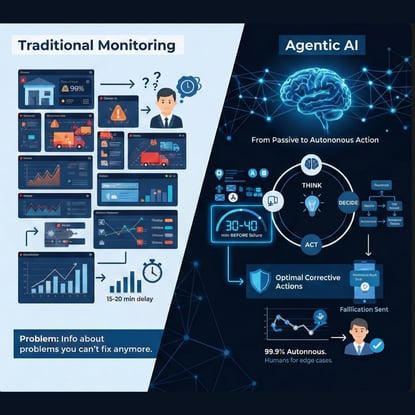
The architecture consists of three integrated elements that work together to transform how urban fulfilment networks deal with operational stress:
Think: The system processes huge amounts of real-time operational data, such as vehicle locations, traffic patterns, order volumes, warehouse capacity, delivery time commitments, and historical performance patterns. This helps get a full picture of the current state of the network and any new risks that may be coming up. Machine learning models, trained on millions of past situations, can identify small patterns that precede operational failures. These models can often find problems 30 to 45 minutes before they show up in standard metrics.
Decide: When the system finds possible failures, it looks at the options for intervention against many complicated factors, like which facilities can handle the extra volume, which routing changes cause the least disruption downstream, which time windows are still open for negotiation, and which actions have the best chance of keeping service commitments. This decision engine works all the time, looking at options again as conditions change and new information comes in.
Act: The system takes corrective actions directly by connecting with delivery management systems. It automatically reroutes vehicles, redistributes orders across facilities, changes scheduling priorities, and coordinates resources without needing human approval for routine actions. People still have control over unusual situations or major operational challenges, but 99.9% of preventive actions happen autonomously.
Real-World Applications:
1. Autonomous Facility Management
The best example of agentic AI in city logistics is in autonomous facility management, particularly in automatically closing and reopening logistics hubs based on current demand and capacity. This level of independence is possible because modern transport management systems work with AI.
Traditional methods of managing hubs depend on set operational parameters. Until they reach a certain level, facilities continue to accept new orders. At that point, supervisors need to decide whether to stop taking more orders or risk operational degradation. This model works fine when things are normal, but it doesn't work when there are sudden spikes in demand, equipment problems, or not enough staff.
Agentic AI systems simultaneously monitor a multitude of factors, including the volume of orders placed, the processing speed, the utilisation of staging areas, the availability of outbound vehicles, the anticipated volume of new orders based on historical trends, and the capacity of downstream hubs. If the system sees that conditions are likely to cause delivery commitments to be missed in the next 2–3 hours, it automatically closes the facility to new orders and sends incoming volume to other places with available capacity.
Critically, these decisions happen before problems become visible on traditional dashboards. The system doesn't wait for a hub to fill up completely. Instead, it acts when predictive models show that the current path will lead to failures, which usually happens when the hub is 85–90% full. This early intervention prevents cascading delays that occur when facilities become overwhelmed.
The system also manages hub reopening autonomously. As processing speeds improve and capacity becomes available, the AI slowly turns the facility back on, changing the way it accepts new orders to match its operational capabilities. This procedure makes sure that everything stays the same - delivering consistency impossible through manual oversight.
2. Fleet Rerouting and Dynamic Optimization
Agentic AI transforms urban fulfilment networks' response to inevitable disruptions, extending beyond facility management. Traffic accidents, severe weather, car breakdowns, and sudden changes in demand all put constant pressure on delivery schedules. Conventional logistics optimisation systems frequently recalculate routes, a reactive approach that accepts delays as inevitable. Libera's capacity and route planning engine show how AI can move from reactive to proactive optimisation.
Agentic systems constantly improve fleet deployment by automatically rerouting vehicles around traffic jams before they cause delays. When a vehicle has mechanical problems, the system quickly gives its remaining deliveries to nearby vehicles that have space, changes their routes to cut down on extra travel time, and updates the delivery windows for customers—all in a matter of seconds.
The system also handles complex optimisations that are hard for human dispatchers to do on a large scale. When one vehicle finishes its route faster than expected and another falls behind, the AI automatically moves deliveries that are still pending from one vehicle to another to keep the workload balanced and meet service commitments. These small changes, made hundreds of times a day, make a big difference in getting things done on time without needing the dispatcher's attention.
.png?width=624&height=304&name=agentic-ai-fleet-optimization-workflow%20(1).png)
3. Predictive Logistics: Preventing Problems Before They Emerge
The most significant aspect of agentic AI is its ability to prevent issues from arising. Predictive logistics can act before issues arise by using ML models to identify trends that occur prior to operational failures.
Using historical data, the system determines which combinations of variables, such as order volume spikes, specific vehicle assignments, delivery routes, warehouse staffing levels, time of day, and weather, are associated with operational exceptions or missed delivery windows. The system automatically modifies procedures when the current circumstances align with these patterns. For instance, it could alter the amount of work completed at each facility, allow more time for complex deliveries, assign new routes to drivers with more experience, or alter routes in advance to avoid locations where delays frequently occur.
This capacity extends beyond supply chain management. It involves determining which equipment requires maintenance before it malfunctions, estimating the amount of capacity required to aid in facility planning, and identifying issues with quality in delivery procedures.
4. Operational Excellence at Six Sigma Levels
Agentic AI has a significant and measurable impact on urban fulfilment. 99.96% on-time delivery rates are reported by organisations using these systems, which is a six-sigma level of operational excellence that was previously unachievable in urban logistics. This performance stems from three main factors:
Elimination of Response Latency: Reducing the time between problem detection and corrective action from minutes to seconds virtually eliminates many failures.
Diminished Human Error: Errors are inevitably introduced when decisions are made manually, under pressure. Regardless of operational stress, autonomous systems consistently apply rigorous analysis when making decisions.
Continuous Learning and Improvement: As machine learning models analyse fresh operational data, they identify subtle patterns and hone intervention tactics.
Businesses report 35% automation of repetitive tasks, 30% quicker resolution of supply chain problems, and a 40% decrease in human error. These enhancements make it possible to implement operational models like guaranteed 10-minute delivery windows in urban settings, that are not possible under traditional management.
Implementation Considerations and Human Oversight
Despite its autonomy, agentic AI doesn't eliminate human involvement in supply chain optimization. Instead, it changes the roles of operations teams from doing tactical tasks to managing strategic ones. Supervisors handle exception management, which is the 0.1% of cases where people need to make decisions because of unusual situations or major changes in operations. The system gives these cases a lot of background information, which helps people make smart choices without requiring deep investigation. Technology for workforce ecosystems can help businesses make sure their teams are well-trained to use these self-driving systems.
For implementation to work, it needs to be fully integrated with the existing AI in the supply chain management system, which includes tools for managing warehouses, transportation, orders, and communication with customers. The agentic system has to use these systems to make decisions while keeping the data consistent and the operations open.
Organisations must establish a clear governance framework that defines what people can and cannot do on their own. These rules should clearly state what decisions the system can make on its own, what decisions need to be approved by a person, and how quickly supervisors should respond when someone asks for help.
The Future of Urban Fulfilment Operations
The trajectory of agentic AI in urban fulfilment points toward increasingly sophisticated autonomous capabilities. Current systems are excellent at tactical interventions, like rerouting vehicles, managing facility capacity, and stopping operational failures from happening right away. The next generation will have the ability to plan strategically, automatically changing the network configuration based on changing demand patterns and syncing with external systems like traffic management infrastructure.
We're also seeing the rise of collaborative autonomy, where different AI systems that manage different parts of the supply chain work together to improve overall performance instead of working in silos. Libera's all-mile logistics platform is a great example of this integrated approach, as it connects autonomous operations across the fulfillment journey.
As cities get bigger and people expect faster delivery, the complexity of fulfilling orders in cities exceeds the ability to handle it with manual processes. Agentic AI isn't just an improvement; it's a technology that makes operational models possible that would be impossible to do on a large scale. For e-commerce logistics companies that handle thousands of orders every day, this ability to work on its own is necessary to keep up with the competition.
Conclusion: Reimagining Supply Chain Intelligence
The emergence of agentic AI signifies a pivotal transformation in our understanding of supply chain intelligence. Conventional systems regard supply chain visibility as a goal in and of itself, offering extensive data for human decision-makers to utilise. This model doesn't take into account how long it takes people to respond in situations where things change faster than they can react.
Agentic AI knows that in today's urban fulfilment operations, the decision cycle needs to work at the speed of machines. Visibility is still important, but it should be used as input for autonomous decision-making, not as something people can see. The system doesn't just tell you that a hub is getting full; it also closes the hub, sends incoming orders to other hubs, and changes how the network works to keep its service commitments.
This system does not replace human intelligence; rather, it enhances it by handling tactical execution, which people often struggle with under pressure, and allowing operational teams to concentrate on strategic decisions that still require human judgement. The result is a big improvement in how well things work: networks that operate with six sigma accuracy, respond to disruptions in seconds, and continuously improve through machine learning.
For organisations that work in metropolitan logistics, the question isn't whether to use agentic AI; it's how quickly they can put these features to use before their competitors gain an unfair advantage. The time of managing the supply chain with dashboards is coming to an end. The era of self-driving supply chain intelligence has begun.

Ready to transform your supply chain operations with autonomous AI? Discover how our warehouse management solutions integrate seamlessly with agentic intelligence, explore our case studies showcasing real-world results, or contact our team to discuss your specific logistics challenges.


.jpg?width=352&name=warehouse-inventory-tracking-with-digital-interface%20(2).jpg)