Self-Healing Routes: Autonomous Path Correction for Spontaneous Urban Closures

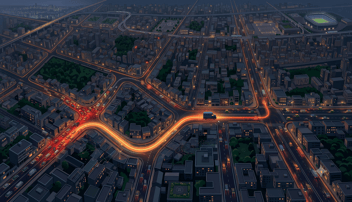
It’s 11:43 am. A massive water main burst on Senapati Bapat Marg in South Mumbai, immediately filling one lane with water and causing huge traffic jams on Senapati Bapat Marg and 3 other streets. These 3 streets are now crippled for the day. 47 delivery riders, sent out on the roads from 11:00 am, following their time- and distance optimized routes, are stuck in a logjam that their routes had never anticipated. Their dispatchers from the control tower, who can see all 47 delivery riders on the screen as dots, start calling them from left to right to start recalculating their routes. It would take 12-18 minutes to recalculate a new route for each of the 47 delivery riders. By that time, 8 time-sensitive slots would have already ended.
Logistics software across India’s major metropolises encounters route failures on a daily basis. The focus then shifts from planning routes to failure to how fast one can recover from such failures in minutes before it impacts customers.
The urban disruption problem is larger than your dashboard shows
Modern last-mile logistics is, at its core, a battle against urban entropy. Cities are unpredictable by nature: road closures, accident diversions, festival processions, waterlogging, construction overruns and political rallies do not schedule themselves around your delivery windows.
While the cost of last-mile delivery appears to be transparent, it is highly likely to be obscured and manifest in many different forms that are not captured in a single line on a P&L account. Last-mile delivery currently accounts for a massive 53% of the total cost of shipping and has increased dramatically over the last 6 years as shippers have been unable to anticipate urban unrest. Several scenarios were developed to outline the potential costs of urban unrest to last-mile delivery. The results from these scenarios are startling – even a handful of unplanned events could increase the distance travelled by 15% and the time taken to complete deliveries by 20% per route per shipper per day. For a company with 200 riders, each undertaking 30 deliveries per shift, this would result in significant operational losses on a daily basis as the number of routes per shipper per day increases.
The World Economic Forum published a white paper on urban logistics a few years ago. One of the findings of that report was that, in the absence of change, last-mile delivery vehicles are likely to add an extra 30 minutes of on-road time per day by 2030 due to urban congestion. That problem is growing, and it’s getting worse.
Why "reactive" route management is already obsolete
Most of the transportation software available today is running in “transportation-reactive mode”. This means that it is done at night before bed, in the morning before drivers hit the road and at night to try to re-optimize the finished tours for the next day. Then there are the normal cases of delayed pickup or en route drop. In this case, the dispatcher receives a call from the driver stating there is a delay. Then the dispatcher figures out the best way to reorganize the remaining pickups and the remaining drops for that driver to get the best out of the rest of that driver’s tour. The dispatcher would then relay the updated information to the driver. The amount of time that would be available to re-optimize would depend on many things.
Many “smart” TMS’s today have real-time routing capabilities; this is typically only updated every 5 minutes. The prior routes calculated by the system, using the prior information the system had, allow for precious time to pass in a congested city where the streets open and close in 90 seconds. In 5 minutes, a street can go from being open to jammed.
What a self-healing route system actually does
The term "self-healing" is specific and operational. It describes a closed-loop architecture that continuously monitors the real-world state of every route, detects anomalies against the planned path, generates optimised alternatives in milliseconds and pushes those alternatives to the driver, without a human issuing the instruction.
Recent studies on dynamic vehicle routing, published in Scientific Reports, have shown that traditional routing models are not effective in practice. This is because they rely on static travel-time assumptions, which don't account for the constant changes in urban traffic. The self-healing route engine is built on top of 4 layers that are very tightly integrated:
1. Continuous real-time data ingestion: Utilize information from real-time APIs and feeds such as traffic; the driver's GPS location from the app; historical data from past deliveries sorted by time and location, as well as other external data points such as police incidents, city events and weather. Do not store this information and then re-inject it in real-time; rather, continuously ingest the information in real-time as it occurs.
2. Anomaly detection and impact scoring machine learning models: By training a host of machine learning models on the vast array of historical delivery events, the system can continuously score in real time a driver’s progress against the planned-out route. By flagging such anomalies as a fall in a drive’s speed for a prolonged period of time as well as a change in GPS location to indicate a driver has come to a stop, the system is then able to score the potential impact on the remainder of a route should such a problem occur. This is to score how many subsequent delivery events will also miss their respective time-sensitive delivery windows as a result of said deviation from the optimal route.
3. Alternative route generation and constraint optimisation: The most critical part of the function of the self-healing route engine is to automatically generate an optimal route and resequence the drops in real time. This needs to take into account several real-time constraints, such as time windows for individual drops, remaining delivery time, remaining hours for the driver’s shift, capacity of the vehicle and rearrangement of the drops based on load, types of vehicles that are not allowed to enter certain zones and service level agreements for critical shipments. All of the constraints above need to be solved in real time on an instance-by-instance basis within a sub-second time frame. This is a well-known classic problem in the field of computing known as the Vehicle Routing Problem with Time Windows (VRPTW).
4. Automatic and silent update to the driver app: The routes that are automatically re-routed as a result of the self-healing route engine will automatically and silently update the driver’s app with the new route(s). In cases where the new route is a large detour and affects the driver’s schedule significantly, the system will automatically send a notification to the control tower of the dispatcher containing a suggested action for them to confirm with a single click.
The business case is no longer ambiguous
When it comes to the costs of implementation for autonomous route correction that logistics service providers can bear, the numbers now speak for themselves. As part of their research on AI in supply chains, the consulting firm McKinsey found that the implementation of dynamic AI routing using AI leads to a 15% to 20% increased average delivery speed for logistics service providers and a decrease of late deliveries of around 30% in comparison to static route planning. The Gartner survey of supply chain technology users 2025 also brings some very positive news for logistics service providers when it comes to the use of AI for dynamic routing and, thereby, also for reducing fuel costs. While the average reduction of fuel costs for survey participants was reported to be between 10% and 15%, this can become very substantial for a CEP service provider or online retailer with a large network of delivery routes in an extremely dense urban environment, such as in India.
The value to the logistics industry of Autonomous Route Correction (ARC) also extends to players in the Courier, Express, Express and Parcel (CEP) markets as well as e-commerce companies that focus on the delivery promise. To deliver within promised timeframes in a constantly changing city, ARC offers a strategic differentiator that one logistics service provider cannot offer against another, i.e., while one may promise SLAs and fail to meet them time and again, the competitor will meet them.
How Libera's platform delivers autonomous path correction
Our capacity and route planning engine was designed from the ground up around the core principle that on-demand logistics route optimisation needs to occur in real time, continuously over time and at the speed of the city.
This is tightly integrated with our Autonomous TMS, which manages all the operational steps to complete a delivery, including creating a trip, assigning a vendor to complete the delivery, implementing ePOD and then reconciling the delivery. So, the same self-healing route resequences the stops for a driver, and the TMS updates the predicted time of completion, which is then visible to the customer in real time; updates the delivery invoiced on the newly predicted time of completion; and logs an exception for the network to learn from.
This is the same architecture that we described in our recent post on agentic AI in urban fulfilment, “Self-healing routes”. In that post, we only described how the same architecture supports self-healing for first- and last-mile logistics. But here, we extend the same capability to all miles so that not only does a spontaneous closure of an on-ramp to a highway lead to the re-sequencing of trips up- and downstream of the vehicle that was on that on-ramp, but also an overloading of a consolidation hub in the middle of a logistics network leads to the re-sequencing of trips up- and downstream of that consolidation hub.
The result is faster routes through the city that remain fast even when the city does not.
The operational shift: From "control tower" to "correction engine"
Over the last 5 years, the control tower has evolved from a ‘nice-to-have' centralised visibility platform, providing real-time information on where every asset in the network is, to a must-have! But simply observing a problem is not enough, and the next 5 years will evolve the control tower from showing problems to solving them.
The next five years in India and other emerging markets of Southeast Asia, Africa and Latin America will be about building platforms that resolve problems for the organisation before they become problems. Self-healing routes are not a feature for such platforms; it is a fundamental architectural requirement to scale in dense and chaotic urban environments, such as India versus Silicon Valley.
The road will always throw up unexpected issues that will affect your network, but the real question is how fast your software can react to such incidents and inform the customer of the delay before they even ask.